Monday, May 4, 2009

Through First Hundred Days New Boss Seems Same as Old Boss


Running on a platform of change, President Obama stated that if elected his actions would be different than those of the previous President. The direction of his administration would be one-hundred and eighty degrees from that of his predecessor. Previous policies would be changed to suit the ideological style of President Obama’s administration. However, since Obama’s election the bearing of his administration, at least on the wars in Afghanistan and Iraq, has been anything but a distinctive change. For example, during the 2008 presidential election campaign Obama promised to withdraw troops from Iraq over a certain shortened time period. Now President Obama has stated that a large number of troops will remain in Iraq for nineteen months, which is longer than promised in the 2008 election, and many for an undefined amount of time after that. In regards to Afghanistan, Obama has actually increased the amount of troops within Afghanistan by 21,000. Strange tactics for someone so different from the previous president.


The way in which Afghanistan and Iraq have been handled through the first one hundred days has disappointing for some of those who supported President Obama during his campaign. Most change that has occurred has been simply semantic in nature. Instead of calling the actions taken against terrorism by the Bush administration label “war on terror”, Obama’s administration calls them “overseas contingency operations”. Instead of calling attacks or actions by rogue groups terrorist attacks Obama’s administration calls them “mancaused disasters”. While we no longer indefinitely hold “enemy combatants”, we do still hold those we catch on the battlefield who do not use the laws of war, which is the definition of enemy combatant, indefinitely. With such little change occurring in the realm of the wars in Afghanistan and Iraq between administrations, former supporters have begun to become disillusioned by President Obama. Some have called his administration merely an extension of Bush’s more accommodationist second term. Yet, the similarities do not only come in the way in which manpower and troop movements are used; spending on the war effort has also changed little to none.


Recently Obama requested $83.4 billion in order to prevent abrupt troop withdrawals. This request brings the total amount spent on the two wars to close to $1 trillion since their beginning in 2001. This request is meant to cover the remainder of operations in 2009. Previously Obama has criticized such supplemental spending moves due to the belief that war spending should be handled by the Pentagon. Yet, once in office the necessity for such supplemental spending bills has become apparent to Obama it seems. Reality has struck President Obama. Now that he is actually in office he is starting to see how difficult it is to operate the wars in Afghanistan and Iraq the way in which he had stated during the campaign. Strategies, tactics, and spending have stayed relatively consistent from the last President to this one.

Sunday, May 3, 2009

Model UN Review


Model UN is a simulated crisis international crisis management activity. Each student is assigned to a country and, once assigned to a country, is given a position within that country’s government to represent. Each student is then expected to research their country and the issues which affect their position within that country. During the course of the simulation the students then would handle a variety of crisis situations and act in their country’s best interest in response to each crisis. All-in-all it sounds somewhat tedious and time-consuming. However, the actual activity itself, once it began, was hectic, fast-paced, and a lot of fun.


The most enjoyable part of the simulation for me was seeing the effects of the actions we took on the countries and the world in which we existed in the UN model. When you spend time coming up with a plan and you see the benefits or cost develop in front of you it is a gratifying feeling. You feel as if you have actually accomplished something. Also, you get to see the responses of the countries around the world to your actions.


I feel as though I was adequately prepared for the exercise. Before undertaking the actual activity we were required to research and write a paper summarizing our country as well as a paper which addressed and summarized issues that were relevant to our particular position within the government of the country which we were representing. Doing the research and constructing the papers actually greatly helped me understand my country and position. Also, the papers helped me to better understand the mindset of my country and what actions would be more realistic to take according to how my country behaves.


The action that I was most proud of which my country took was the construction of an effective contingency plan for actions to take in case of an attack from another country. We researched what defense strategy would be most effective and found one from an American General that had been constructed by him during war games. The strategy pitted the American Naval Fleet against the virtually non-existent Iranian Navy. Through using unconventional means and methods of attack the American General was able to largely destroy the American Naval force. We constructed a contingency plan along the lines of the one which the General had constructed and I was proud of this action. No other country showed the same initiative as us.


I wish our group had been more active with open confrontation. We were repeatedly being threatened by Iraq yet we never undertook any real action until almost the end of the simulation. I was disappointed by this. I felt as though we should have initiated action against the Iraqi threat much sooner than we actually did. We had the means and the plan yet we were hesitant to pull the trigger.

Friday, March 20, 2009

The Iranian Military and Ministry of Defense


The Armed Forces of the Islamic Republic of Iran is one of the largest and most powerful military forces in the Middle East. Numbering at about 945,000 in personnel, the Iranian forces consists of four branches of service (Islamic Republic of Iran Army, Islamic Republic of Iran Navy, Islamic Republic of Iran Air Force, and the Islamic Republic of Iran Air Defenses) and one branch of service, The Army of the Guardians of the Islamic Revolution, that possesses its own five branches of military service (Navy, Air Force, Ground Forces, Quds Force, and Basij forces), with the number serving in The Army of the Guardians of the Islamic Revolution estimated at 125,000 of the overall 945,000 serving. The Quds Force is the Special Forces unit of the Iranian military and is one of the best Special Forces branches in the world. Quds Forces are known to have a focused support in Hezbollah actions in Lebanon. Also, Quds Forces have been accused involvement in and support for the Al Qaeda insurgency in Iraq and Afghanistan. The Basij is a paramilitary volunteer unit that is mostly comprised of boys too young to legally serve and old me. Members of the Basij are not allowed to carry weapons however, due to the fact that they are a volunteer force, they cannot be sued in the way police and public officials can. Therefore, it is extremely difficult to hold anyone accountable for any excessive or brutish actions if committed by a member of the Basij. Iran also possesses the world’s largest paramilitary force. Service is required of all men at the age of 19 and the service length requirement is 18 months. The current Iranian Minister of Defense is Mustafa Mohammad-Najjar however, controls nothing more than planning logistics and funding of the Iranian armed forces. The in-the-field military operational command does not fall under the jurisdiction of the Ministry and Minister of Defense. Iran is currently listed as a state sponsor of terrorism which makes it subject to UN, US, and EU sanctions.

Before the Islamic Revolution in Iran, the Iranian military industry’s main focus was assembling weapons for foreign usage. Most of Iran’s weapons prior to 1979 were imported from foreign distributers, mostly the United States and Europe. From 1971 to 1975 the Shah of Iran spent $8 billion on weapons from just the United States. Congress was worried by this massive spending and tightened its law on arms exports. However, the United States still sold large amounts of weapons to Iran up until the Islamic Revolution of 1979. After the Islamic Revolution Iran was left isolated and had little technological expertise of its own. Therefore, Iran was forced to look to its own resources for military strength and weapons development. At this point the Iranian military industry was created. The main focus of this industry has been on missile and missile systems development; however the Iranian military industry has developed its own tanks, armored personnel carriers, submarines, and fighter planes. In 2009 the Iranian government focused 10.5% of its GDP on military spending with a total amount of $36 billion used on military development. Iran has developed missile systems with the capability of reaching distances up to 1300km away. The most notable missiles and missile systems that have been developed by Iran are the Fajr-3 (MIRV), Hoot, Kowsar, Fateh-110, and Shahab-3. Iran has also developed unmanned aerial vehicles which have the capability of spying on their targets without being noticed or spotted. In 2006 an Iranian unmanned vehicle spied on a US carrier for around 25 minutes without being spotted. There has also been speculation in recent years over Iran’s hopes for nuclear power. While these claims are yet to be substantiated Iran is working to create radioactive fuel for energy purposes that could possibly be used in a nuclear weapon.

Throughout the years Iran has been involved in a number of noteworthy military conflicts, however the most important of these conflicts in recent history was the Iran-Iraq war which spanned from 1980 to 1988. The conflict was started through a series of border disputes between Iraq and Iran. Another factor was the fear on the part of Iraq over a Shia insurgency within Iraq ignited by Iran’s Islamic Revolution. In September of 1980 Iraq invaded Iran and hoped to have the current unrest within Iran and the element of surprise on their side, yet Iraq only made limited progress within the borders of Iran. The invasion stalled in 1981 and by 1982 Iran had gained pretty much all of the territory they lost in the initial push back. The conflict is often compared to World War I in its tactics and weapons usage. The conflict was marked by large scale trench warfare and human wave attacks, as well as extensive use of biological and chemical warfare on the part of Iraq against soldiers and citizens of Iran. In this conflict the United States supported Iraq, yet still indirectly supplied Iran with weapons. The conflict resulted in the loss of mass amounts of lives on both the side of the Iranians and the Iraqis. Iran was left much weaker at the end of the war and Iraq was left much stronger. As a result of this military depletion, an ambitious military rebuilding project was started after the war with the hopes of creating a fully fledged military industry within Iran. The last prisoners of war from the conflict were exchanged in 2003.

Overall, Iran’s military is one of the strongest in the region with 945,000 estimated members currently serving. Iran may be actively seeking nuclear weapons and nuclear weapons systems. With 10.5% of its GDP being spent on military funding, Iran has one of the highest percentages of GDP spent on military development in the world. The actual in-the-field military activities of the armed forces of Iran are controlled by the Ayatollah with the Minister of Defense simply controlling the planning of military logistics and the funding of military programs. Iran’s military and military attitude is an ambitious one, which raises concerns with the power players around the world. Iran has been subject to sanctions by the US, UN, and EU for its ambitions to create a nuclear program and its involvement in terrorist activities.

Thursday, March 12, 2009

Summary of the Status of Iran


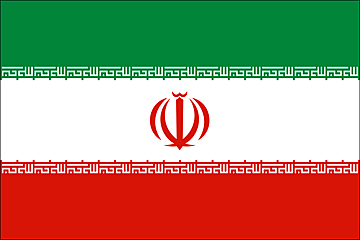
Iran was known as Persia until the twentieth century. A nation ruled by a theocracy, strict-lined conservative policy is enacted and enforced. The president, Mahmud Ahmadi-Nejad, is a hard-line old school conservative leader. The country has been subject to sanctions due to its active uranium enrichment program. Recognized as a state that sponsors terrorism, a high degree of tensions exist in the relations between Iran and the United States of America. Geographically it is located in the mountainous region of the Middle East bordering Iraq and Pakistan as well as the Gulf of Oman, the Persian Gulf, and the Caspian Sea. The climate is arid and dry and has subjected the country with periods of drought in the past.


The population of Iran is mostly young to middle aged adult with 72.3% of the country being located in the age range of 15-64 years old and a median age of 26.4 years old. The literacy rate of the country is somewhat low with only 77% of those over the age of 15 capable of reading. The country needs to work to improve its literacy rate among adults because the ability to read is pivotal to social and cultural progress. Iran spends close to the same percentage of its GDP on education as the United States with a total percentage expenditure of 5.1% of the country’s GDP on education. The country suffers from a fairly high infant mortality rate in comparison to western countries such as the United States of America with an infant mortality rate of 36.93 deaths per 1,000 live births. The country also has a fair life expectancy rate at 70.86 years.


The economy of Iran is extremely dependent on its oil market and production. The state sector is corrupt and inefficient and there is little room for private sector growth. Various factors including price controls and subsidies restrict economic growth in the country. Inflation is extremely high with a rate of 28%. Also, unemployment is at an unacceptable height of 12.5% of the available work force currently without a job. The lack of ability for the higher educated youths to acquire a job has led to a large number of youths leaving the country to seek employment elsewhere. This leads to a shortage of skilled workers, laborers, and minds in the country. The inflation rate must be brought down as well as the unemployment rate if the country wishes to improve its international standing economically.


Military service in the country is mandatory at the age of 19 for all males and they must serve 18 months. Military service for females is not a requirement. Iran has 34,344,352 citizens available for military service. 1,494,322 of the population of Iran reach the age for military service annually. 2.5% of Iran’s GDP is spent on the military.


Iran suffers from a large problem in human trafficking and because of the country’s lack of effort to prevent and improve the situation has received a tier 3 rating on the human trafficking scale. Iran suffers from a high degree of problems with illicit drugs, especially heroin. The country is one of the primary routes for heroin shipments to Europe. Iran has one of the highest opiate addiction rates in the world and suffers from its lack of anti-money laundering laws. The country has reached out to its neighbors to share counter-drug intelligence.


Overall, Iran is struggling highly economically and educationally. Much needs to be done to improve both situations. Perhaps spending more of its GDP on improving the educational situation could help with the literacy issue. Also, raising price controls and removing subsidies could help improve the economic situation. Another tactic that could help the economy would be to encourage private-sector-led economic growth. This could help create jobs to lower the unemployment rate.