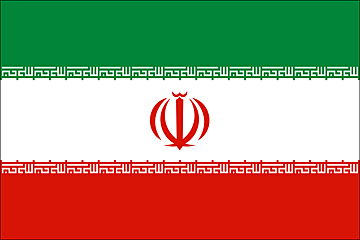
Iran was known as Persia until the twentieth century. A nation ruled by a theocracy, strict-lined conservative policy is enacted and enforced. The president, Mahmud Ahmadi-Nejad, is a hard-line old school conservative leader. The country has been subject to sanctions due to its active uranium enrichment program. Recognized as a state that sponsors terrorism, a high degree of tensions exist in the relations between Iran and the United States of America. Geographically it is located in the mountainous region of the Middle East bordering Iraq and Pakistan as well as the Gulf of Oman, the Persian Gulf, and the Caspian Sea. The climate is arid and dry and has subjected the country with periods of drought in the past.
The population of Iran is mostly young to middle aged adult with 72.3% of the country being located in the age range of 15-64 years old and a median age of 26.4 years old. The literacy rate of the country is somewhat low with only 77% of those over the age of 15 capable of reading. The country needs to work to improve its literacy rate among adults because the ability to read is pivotal to social and cultural progress. Iran spends close to the same percentage of its GDP on education as the United States with a total percentage expenditure of 5.1% of the country’s GDP on education. The country suffers from a fairly high infant mortality rate in comparison to western countries such as the United States of America with an infant mortality rate of 36.93 deaths per 1,000 live births. The country also has a fair life expectancy rate at 70.86 years.
The economy of Iran is extremely dependent on its oil market and production. The state sector is corrupt and inefficient and there is little room for private sector growth. Various factors including price controls and subsidies restrict economic growth in the country. Inflation is extremely high with a rate of 28%. Also, unemployment is at an unacceptable height of 12.5% of the available work force currently without a job. The lack of ability for the higher educated youths to acquire a job has led to a large number of youths leaving the country to seek employment elsewhere. This leads to a shortage of skilled workers, laborers, and minds in the country. The inflation rate must be brought down as well as the unemployment rate if the country wishes to improve its international standing economically.
Military service in the country is mandatory at the age of 19 for all males and they must serve 18 months. Military service for females is not a requirement. Iran has 34,344,352 citizens available for military service. 1,494,322 of the population of Iran reach the age for military service annually. 2.5% of Iran’s GDP is spent on the military.
Iran suffers from a large problem in human trafficking and because of the country’s lack of effort to prevent and improve the situation has received a tier 3 rating on the human trafficking scale. Iran suffers from a high degree of problems with illicit drugs, especially heroin. The country is one of the primary routes for heroin shipments to Europe. Iran has one of the highest opiate addiction rates in the world and suffers from its lack of anti-money laundering laws. The country has reached out to its neighbors to share counter-drug intelligence.
Overall, Iran is struggling highly economically and educationally. Much needs to be done to improve both situations. Perhaps spending more of its GDP on improving the educational situation could help with the literacy issue. Also, raising price controls and removing subsidies could help improve the economic situation. Another tactic that could help the economy would be to encourage private-sector-led economic growth. This could help create jobs to lower the unemployment rate.

