Friday, March 20, 2009

The Iranian Military and Ministry of Defense


The Armed Forces of the Islamic Republic of Iran is one of the largest and most powerful military forces in the Middle East. Numbering at about 945,000 in personnel, the Iranian forces consists of four branches of service (Islamic Republic of Iran Army, Islamic Republic of Iran Navy, Islamic Republic of Iran Air Force, and the Islamic Republic of Iran Air Defenses) and one branch of service, The Army of the Guardians of the Islamic Revolution, that possesses its own five branches of military service (Navy, Air Force, Ground Forces, Quds Force, and Basij forces), with the number serving in The Army of the Guardians of the Islamic Revolution estimated at 125,000 of the overall 945,000 serving. The Quds Force is the Special Forces unit of the Iranian military and is one of the best Special Forces branches in the world. Quds Forces are known to have a focused support in Hezbollah actions in Lebanon. Also, Quds Forces have been accused involvement in and support for the Al Qaeda insurgency in Iraq and Afghanistan. The Basij is a paramilitary volunteer unit that is mostly comprised of boys too young to legally serve and old me. Members of the Basij are not allowed to carry weapons however, due to the fact that they are a volunteer force, they cannot be sued in the way police and public officials can. Therefore, it is extremely difficult to hold anyone accountable for any excessive or brutish actions if committed by a member of the Basij. Iran also possesses the world’s largest paramilitary force. Service is required of all men at the age of 19 and the service length requirement is 18 months. The current Iranian Minister of Defense is Mustafa Mohammad-Najjar however, controls nothing more than planning logistics and funding of the Iranian armed forces. The in-the-field military operational command does not fall under the jurisdiction of the Ministry and Minister of Defense. Iran is currently listed as a state sponsor of terrorism which makes it subject to UN, US, and EU sanctions.

Before the Islamic Revolution in Iran, the Iranian military industry’s main focus was assembling weapons for foreign usage. Most of Iran’s weapons prior to 1979 were imported from foreign distributers, mostly the United States and Europe. From 1971 to 1975 the Shah of Iran spent $8 billion on weapons from just the United States. Congress was worried by this massive spending and tightened its law on arms exports. However, the United States still sold large amounts of weapons to Iran up until the Islamic Revolution of 1979. After the Islamic Revolution Iran was left isolated and had little technological expertise of its own. Therefore, Iran was forced to look to its own resources for military strength and weapons development. At this point the Iranian military industry was created. The main focus of this industry has been on missile and missile systems development; however the Iranian military industry has developed its own tanks, armored personnel carriers, submarines, and fighter planes. In 2009 the Iranian government focused 10.5% of its GDP on military spending with a total amount of $36 billion used on military development. Iran has developed missile systems with the capability of reaching distances up to 1300km away. The most notable missiles and missile systems that have been developed by Iran are the Fajr-3 (MIRV), Hoot, Kowsar, Fateh-110, and Shahab-3. Iran has also developed unmanned aerial vehicles which have the capability of spying on their targets without being noticed or spotted. In 2006 an Iranian unmanned vehicle spied on a US carrier for around 25 minutes without being spotted. There has also been speculation in recent years over Iran’s hopes for nuclear power. While these claims are yet to be substantiated Iran is working to create radioactive fuel for energy purposes that could possibly be used in a nuclear weapon.

Throughout the years Iran has been involved in a number of noteworthy military conflicts, however the most important of these conflicts in recent history was the Iran-Iraq war which spanned from 1980 to 1988. The conflict was started through a series of border disputes between Iraq and Iran. Another factor was the fear on the part of Iraq over a Shia insurgency within Iraq ignited by Iran’s Islamic Revolution. In September of 1980 Iraq invaded Iran and hoped to have the current unrest within Iran and the element of surprise on their side, yet Iraq only made limited progress within the borders of Iran. The invasion stalled in 1981 and by 1982 Iran had gained pretty much all of the territory they lost in the initial push back. The conflict is often compared to World War I in its tactics and weapons usage. The conflict was marked by large scale trench warfare and human wave attacks, as well as extensive use of biological and chemical warfare on the part of Iraq against soldiers and citizens of Iran. In this conflict the United States supported Iraq, yet still indirectly supplied Iran with weapons. The conflict resulted in the loss of mass amounts of lives on both the side of the Iranians and the Iraqis. Iran was left much weaker at the end of the war and Iraq was left much stronger. As a result of this military depletion, an ambitious military rebuilding project was started after the war with the hopes of creating a fully fledged military industry within Iran. The last prisoners of war from the conflict were exchanged in 2003.

Overall, Iran’s military is one of the strongest in the region with 945,000 estimated members currently serving. Iran may be actively seeking nuclear weapons and nuclear weapons systems. With 10.5% of its GDP being spent on military funding, Iran has one of the highest percentages of GDP spent on military development in the world. The actual in-the-field military activities of the armed forces of Iran are controlled by the Ayatollah with the Minister of Defense simply controlling the planning of military logistics and the funding of military programs. Iran’s military and military attitude is an ambitious one, which raises concerns with the power players around the world. Iran has been subject to sanctions by the US, UN, and EU for its ambitions to create a nuclear program and its involvement in terrorist activities.

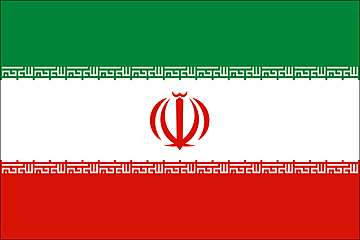
Thursday, March 12, 2009

Summary of the Status of Iran


Iran was known as Persia until the twentieth century. A nation ruled by a theocracy, strict-lined conservative policy is enacted and enforced. The president, Mahmud Ahmadi-Nejad, is a hard-line old school conservative leader. The country has been subject to sanctions due to its active uranium enrichment program. Recognized as a state that sponsors terrorism, a high degree of tensions exist in the relations between Iran and the United States of America. Geographically it is located in the mountainous region of the Middle East bordering Iraq and Pakistan as well as the Gulf of Oman, the Persian Gulf, and the Caspian Sea. The climate is arid and dry and has subjected the country with periods of drought in the past.


The population of Iran is mostly young to middle aged adult with 72.3% of the country being located in the age range of 15-64 years old and a median age of 26.4 years old. The literacy rate of the country is somewhat low with only 77% of those over the age of 15 capable of reading. The country needs to work to improve its literacy rate among adults because the ability to read is pivotal to social and cultural progress. Iran spends close to the same percentage of its GDP on education as the United States with a total percentage expenditure of 5.1% of the country’s GDP on education. The country suffers from a fairly high infant mortality rate in comparison to western countries such as the United States of America with an infant mortality rate of 36.93 deaths per 1,000 live births. The country also has a fair life expectancy rate at 70.86 years.


The economy of Iran is extremely dependent on its oil market and production. The state sector is corrupt and inefficient and there is little room for private sector growth. Various factors including price controls and subsidies restrict economic growth in the country. Inflation is extremely high with a rate of 28%. Also, unemployment is at an unacceptable height of 12.5% of the available work force currently without a job. The lack of ability for the higher educated youths to acquire a job has led to a large number of youths leaving the country to seek employment elsewhere. This leads to a shortage of skilled workers, laborers, and minds in the country. The inflation rate must be brought down as well as the unemployment rate if the country wishes to improve its international standing economically.


Military service in the country is mandatory at the age of 19 for all males and they must serve 18 months. Military service for females is not a requirement. Iran has 34,344,352 citizens available for military service. 1,494,322 of the population of Iran reach the age for military service annually. 2.5% of Iran’s GDP is spent on the military.


Iran suffers from a large problem in human trafficking and because of the country’s lack of effort to prevent and improve the situation has received a tier 3 rating on the human trafficking scale. Iran suffers from a high degree of problems with illicit drugs, especially heroin. The country is one of the primary routes for heroin shipments to Europe. Iran has one of the highest opiate addiction rates in the world and suffers from its lack of anti-money laundering laws. The country has reached out to its neighbors to share counter-drug intelligence.


Overall, Iran is struggling highly economically and educationally. Much needs to be done to improve both situations. Perhaps spending more of its GDP on improving the educational situation could help with the literacy issue. Also, raising price controls and removing subsidies could help improve the economic situation. Another tactic that could help the economy would be to encourage private-sector-led economic growth. This could help create jobs to lower the unemployment rate.

Thursday, February 19, 2009

Obama's Housing Plan is Insufficient and Short Sighted


Many are hopeful that the new homeowner bailout plan will help to alleviate the pressure currently enveloping homeowners and the housing market. President Obama’s three part plan of changing lending rules to help millions of homeowners refinance, providing $75 billion to help millions of the most at risk for foreclosure, and giving $200 billion to mortgage giants Freddie Mac and Fannie Mae to help keep mortgage rates low is the most aggressive proposal yet to help with the housing crisis. The purpose of the plan is to help provide millions of homeowners that have come to the point of financial ruin a chance to rebuild. The plan will be most effective in states such as Arizona, Florida, Colorado, and California, all of which have been hit hard by the housing crisis. The strategy is to hopefully have a plan that will start working as quickly as possible in order to reach those in the most need as soon as possible. The administration feels that the sooner those on the bottom receive help the better for the long term of the housing market. Meant to immediately help around nine million home owners, the plan is also meant to target those on the verge of falling into the red zone. Sheila Blair, head of the Federal Deposit Insurance Corporation, feels as though the effects of this plan could start showing as early as next month,
“I believe you'll start seeing a real impact in March, with meaningful, long term, sustainable modifications," Bair told ABC
However, is this plan, so lauded by man in the Democratic Party, even original?

The plan which Obama is proposing has drawn comparisons by many to a plan which was developed by John McCain during the Presidential race. Obama’s plan is meant to stop foreclosures before they have a chance to occur, an idea which can even be as much as pinpointed as to when exactly it was first introduced by John McCain, the second presidential debate. During the campaign Obama stated
“Taxpayers shouldn't be asked to pick up the tab for the very folks who helped create this crisis. And that's the problem with Senator McCain's risky idea."
Obama also stated that the plan from Senator McCain, which was estimated to cost around $300 billion, would be too expensive. Yet the plan now being introduced by President Obama is going to bailout those that created the crisis, cost $275 billion, and be paid for by who else than the American taxpayer. Instead of coming up with a new solution for a problem so plaguing the American economy as many believed Obama would do, and as Obama led the American public to believe he would do, the Obama administration simply made minor adjustments to a plan that was already introduced during the campaign. Another disappointment from the Obama camp in what is still the infancy stage of his presidency. Still, this issue of originality over the housing bailout plan is minor to the major issues I see with the bill. This plan appears to me to be an effort to provide an easy way out for those that made irresponsible and knowingly reckless purchases of homes that they were aware they would never be able to afford.

The American taxpayers are paying people and banks to do that which they were already supposed to be doing.
“President Obama’s massive mortgage-bailout plan is nothing more than a thinly disguised entitlement program that redistributes income from the responsible 92 percent of home-owning mortgage holders who pay their bills on time to the irresponsible defaulters who bought more than they could ever afford. This is Obama’s spread-the-wealth program in action.”, Larry Kudlow National Review Online
The $275 billion dollar plan is simply creating further debt on a quick fix for the housing crisis. While expanding the control and power of major mortgage owners Fannie Mae and Freddie Mac, the Obama plan does nothing to alleviate the pressure on small-time mortgage lenders or Wall Street. Instead of throwing money at those that made irresponsible decisions to purchase homes well out of their means bracket, Obama and his administration should do as much as possible to support new families looking to buy starter homes. After all in a free-market society that is how economic problems are fixed, by supporting an ever growing number of new that wish to buy into the system. Not by using big government to bail out the few at the cost of many. After all it is important to realize that while the prices of homes continue to drop, the number of those buying homes is continuing to rise. Have some faith in the free market system, President Obama, and try to develop some long term solutions for the issues at hand instead of quick, draining, and short-term solutions for problems that are of far greater reach. Deal with the loans that were issued as securities and help out all mortgage writers, not just the two major mortgage brokers that the government can control. Spark the economy, do not continue to impede its growth.

Thursday, February 12, 2009

War in Afghanistan Could Be More of a Quagmire Than Iraq


The United States will possibly add more troops to the war effort in Afghanistan soon. It seemed as though the Taliban had been crushed and sent home with its tail between its legs in 2001. However, it has become apparent that the Taliban has regrouped, and this time they are stronger and far more fiercely dedicated to the fight. This regrouping is believed to have taken place in neighboring Pakistan and the Pakistani bases are believed to have been the Taliban’s launching point into Afghanistan. Slowly but surely, and with some local resistance, the Taliban has swept across Afghanistan to now control a large portion of the country. Along the way they have picked up some valuable tribal allies. Important talks in Afghanistan have begun with U.S. envoy Richard Holbrooke having been sent in for the discussions. The focus of the discussions will be to determine what level of increased involvement for the U.S. is necessary to establish security in Afghanistan. It is believed that the U.S. will add more troops to the effort in Afghanistan but exactly how many is still undetermined. With the fighting in Afghanistan intensifying it is believed that more troops are necessary in order to establish security for the Afghan presidential elections on August 20. However, will more troops truly solve the problem in Afghanistan, or merely create another quagmire such as the one in Iraq? We have seen that heavily splintered nation-states are extremely difficult to bring together through the example in Iraq. When a battle between peoples has been raging for thousands of years, it is difficult to believe that those from the outside could step in and solve the problem in a far shorter period of time. If we have learned anything from the Iraq war it is that throwing more troops into the fray is, if anything, only a quick fix. There comes a point in which one must concede that some battles are unwinnable, some problems unsolvable. The Middle East is the perfect example of such a problem. The wars and fighting that takes place in this area of the world are not merely over land or resources, but religious doctrines and beliefs. It is difficult to believe that sending our troops into the area will do much to help such a deep seeded and long lasting struggle. How can you bring together a country which has never really been unified before? Unification is something that must happen from within a country, through the means of that country’s people. Not from the efforts of an outside force. Such a unification as this will be weak and brief. If the United States is to assist in unifying the country, however, it will need to be able to trust its connections within the country. This is something that the United States has not been able to do.


Take for example the missing weapons in Afghanistan. The United States spent hundreds of millions of dollars on obtaining and shipping around 242, 000 weapons to help equip the Afghan National Security Forces. However, 87, 000 of those weapons are now missing and unaccounted for within Afghanistan. The missing weapons are blamed on mistakes made throughout the supply chain. Still, it is easy to believe that some, if not most, of those mistakes were intentional. This puts the U.S. in the position of possibly battling weapons that were paid for by the U.S. and shipped over by the U.S., a scenario which should never occur.

"What if we had to tell families [of U.S. soldiers] not only why we are in Afghanistan but why their son or daughter died at the hands of an insurgent using a weapon purchased by the United States taxpayers? But that's what we risk if we were to have tens of thousands of weapons we provided washing around Afghanistan, off the books," Rep. John Tierney, D-Massachusetts
Even many of the experts are not sold on America’s ability to succeed in Afghanistan. Without the ability to trust the connections within the country how can any headway in the battle for unification be expected to take place? After all the foundation of any unified state is trust. Not only are the difficulty of unification of Afghanistan and the inability for U.S. forces to fully trust its contacts within Afghanistan serious impediments to success on the Afghan front, but also the history of Afghanistan with invaders and the layout of the country itself seem to be working against the United States.


Afghanistan has garnered the nickname “graveyard of empires” because it has crushed forces from many nations much stronger than itself. Afghanistan has never truly been a modernized, unified country. It has always operated as a tribal society. The Taliban forces that America is fighting are located in mostly rural areas and are well funded. Much of the Taliban forces are located in village areas that are scattered throughout a large area. This tribal, rural area operates under practically free reign due to the fact that there is a distinct separation between the rural areas and the cities. These rural areas are dominated by drug lords, most of which are involved in the drug trade and backing the Taliban. Therefore, the Taliban is currently in possession of the dominant location of the countryside, operating with practically free reign in this area of countryside, and being backed by drug money which runs into the hundreds of millions of dollars brought in annually. Such a combination is most certainly a recipe for failure, not success, in Afghanistan. Yet it seems as though President Obama is going to send a large number of more troops into the country to try and fix the deteriorating situation. The new administration was supposed to have a different and more effective strategy than the previous one? It seems as though the new administration is merely continuing the same tried and failed techniques as the last. Has nothing been learned from the conflict in Iraq? A full and unapologetic change is needed in the strategy for America’s Middle East involvement. Yet it seems little change is on the way from a President that ran on the platform of change.